A Brief History of the World’s Largest Companies
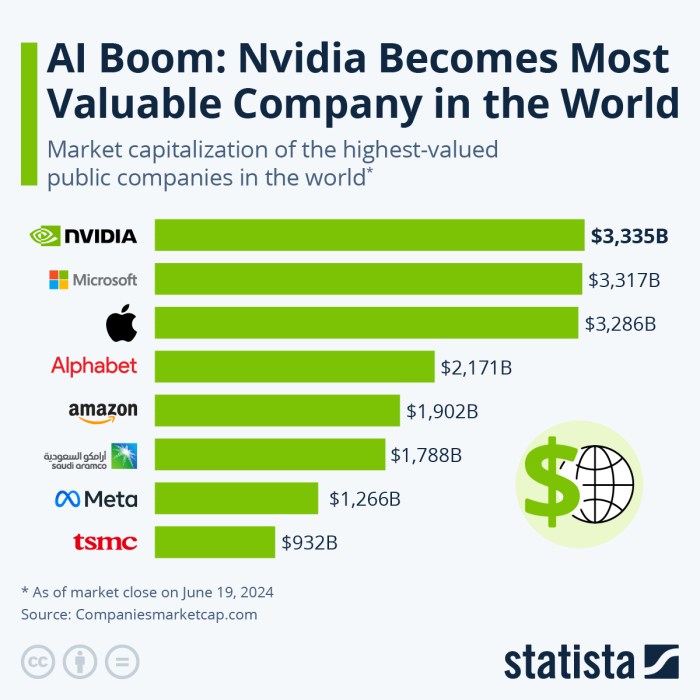
World biggest company net worth – The world of business is filled with tales of rags-to-riches stories, innovative ideas, and strategic risk-taking that have catapulted companies to unprecedented heights of success. From humble beginnings to global dominance, the largest companies in the world have overcome numerous challenges and adapted to changing market dynamics to remain at the forefront of their industries.As we explore the history of these business giants, we begin to understand the secrets behind their enduring success.
Many of these companies were founded during times of economic downturn or social upheaval, forcing their leaders to think creatively and invest in innovative solutions to stay ahead of the curve.
Early Milestones and Achievements
The history of the world’s largest companies is a testament to the power of innovation and strategic risk-taking. For instance, Coca-Cola, founded in 1886 by pharmacist John Pemberton, started as a small-scale operation in Atlanta, Georgia. The company’s early success can be attributed to its innovative approach to bottling and distribution, which enabled it to reach a wider audience and establish itself as a household name.Similarly, Microsoft, founded in 1975 by Bill Gates and Paul Allen, began as a small software company in Albuquerque, New Mexico.
The duo’s innovative approach to programming and user-friendly interface helped Microsoft become the leading computer software company in the world.
Impact of Historical Events on Company Trajectory
Historical events have played a significant role in shaping the trajectory of these companies. The Great Depression, for instance, led many companies to focus on cost-cutting measures and investing in research and development to stay competitive. This strategic shift enabled them to adapt to changing market conditions and come out stronger on the other side.Similarly, the rise of the internet and social media has forced companies to innovate and adapt to new technologies to remain relevant.
The likes of Amazon, founded in 1994 by Jeff Bezos, have successfully leveraged e-commerce platforms to revolutionize the way people shop and interact with their customers.
Top 10 Largest Companies in History
Here is a list of the top 10 largest companies in history, noting their current status and what led to their decline or continued success:
1. Walmart (founded in 1962): With over $500 billion in annual revenue, Walmart is the largest private employer in the world. Initially focusing on discount retailing, Walmart expanded its operations globally and diversified its product offerings to remain competitive.
2. ExxonMobil (founded in 1882): With a market capitalization of over $400 billion, ExxonMobil is one of the largest publicly traded companies in the world. Its strategic investment in the development of petroleum-based products ensured its continued success.
3. Apple (founded in 1976): With a market capitalization of over $2 trillion, Apple is one of the most valuable companies in the world. Its early adoption of innovation and strategic risk-taking enabled it to become a leader in the tech industry.
4. Microsoft (founded in 1975): With a market capitalization of over $2 trillion, Microsoft is one of the most valuable companies in the world. Its early focus on software development and innovative products enabled it to become the leading computer software company in the world.
5. Amazon (founded in 1994): With a market capitalization of over $1 trillion, Amazon is one of the fastest-growing companies in the world. Its early adoption of e-commerce platforms and strategic investment in cloud computing enabled it to become the leading online retailer.
6. Google (founded in 1998): With a market capitalization of over $1 trillion, Google is one of the fastest-growing companies in the world. Its early focus on search engine advertising and innovative products enabled it to become the leading search engine company.
7. IBM (founded in 1911): With a market capitalization of over $500 billion, IBM is one of the largest technology companies in the world. Its early focus on mainframe computing and strategic investment in research and development enabled it to become a leader in the tech industry.
8. Procter & Gamble (founded in 1837): With a market capitalization of over $500 billion, Procter & Gamble is one of the largest consumer goods companies in the world. Its early focus on product innovation and strategic investment in marketing enabled it to become a household name.
9. Toyota (founded in 1937): With a market capitalization of over $200 billion, Toyota is one of the largest automotive companies in the world. Its early focus on quality and innovation enabled it to become a leader in the automotive industry.
10. Volkswagen (founded in 1937): With a market capitalization of over $100 billion, Volkswagen is one of the largest automotive companies in the world. Its early focus on quality and innovation enabled it to become a leader in the European automotive market.
The Role of Corporate Governance in Shaping the Net Worth of the World’s Biggest Companies

Effective corporate governance is a critical driver of the growth and success of global companies, ultimately influencing the net worth of these organizations. A strong corporate governance framework enables companies to navigate complex markets, manage risk, and capitalize on new opportunities, all of which contribute to their financial health and stability. By examining the role of corporate governance in shaping the net worth of the world’s biggest companies, we can better understand the factors that underpin their success.
The Interplay between Company Boards of Directors and Management Teams
A well-functioning corporate governance structure involves a harmonious relationship between a company’s board of directors and management team. The board is responsible for setting the overall direction and strategy of the organization, while the management team is responsible for executing these plans. To ensure effective communication and decision-making between the two parties, companies often establish a system of checks and balances.
For example, boards may delegate certain responsibilities to committees, such as audit or compensation committees, to ensure that critical functions are being carried out efficiently and effectively.In the case of a company like Apple, its board of directors has established a governance structure that emphasizes the importance of transparency and accountability. Apple’s board is composed of experienced industry leaders who bring a range of skills and expertise to their roles.
They work closely with the company’s management team, led by CEO Tim Cook, to set strategic objectives and make key decisions. This collaborative approach has helped Apple maintain its position as one of the world’s largest and most successful companies.
Successful Corporate Governance Practices
A number of successful corporate governance practices have contributed to the growth of the world’s largest companies. These practices include:
- Independent Board Composition: Companies that have a high proportion of independent directors on their boards tend to perform better financially. Independent directors bring objective perspectives and expertise to the decision-making process, helping to ensure that the interests of shareholders are represented.
- Transparency and Disclosure: Transparent companies that maintain high standards of financial reporting and disclosure are more likely to attract and retain investors. This is because investors value access to accurate and timely information, which enables them to make informed decisions about their investments.
- Strong Risk Management: Companies that have robust risk management practices in place tend to be more resilient and adaptable in the face of changing market conditions. This is because they are better able to identify and mitigate potential risks, ensuring that their financial performance is not compromised.
“Good corporate governance is essential for building trust with investors, customers, and other stakeholders. It helps to create a culture of transparency, accountability, and integrity within an organization, which is critical for its long-term success and sustainability.”
Regulatory Frameworks and Global Economic Trends Shaping the World’s Largest Companies

In today’s fast-paced and interconnected global economy, the world’s largest companies must navigate a complex landscape of regulatory frameworks and economic trends to stay ahead of the competition. From tax laws and labor regulations to trade agreements and monetary policies, these frameworks and trends play a critical role in shaping the growth, profitability, and global market position of the world’s largest companies.
The Impact of Regulatory Environments, World biggest company net worth
Regulatory environments have a profound impact on the operations and profitability of the world’s largest companies. From taxes and labor laws to environmental regulations and intellectual property rights, these frameworks dictate how companies can do business, how they can innovate, and how they can access new markets. For instance, companies operating in countries with high tax rates may face significant operating costs, while those operating in countries with more favorable tax laws may be able to allocate more resources to research and development.
- Tax laws and regulations: Tax laws and regulations vary widely across countries and can have a significant impact on a company’s profitability. In some countries, taxes can be as high as 40% of a company’s profits, while in others, they can be as low as 10%.
- Labor laws and regulations: Labor laws and regulations also play a critical role in shaping the global market position of companies. For instance, countries with strong labor unions may require companies to pay higher wages and benefits, while countries with weaker labor unions may not.
- Environmental regulations: Environmental regulations are becoming increasingly stringent as countries prioritize sustainability and environmental protection. Companies operating in countries with strict environmental regulations may need to invest in new technologies and processes to reduce their environmental impact.
The Impact of Global Economic TrendsGlobal economic trends also play a significant role in shaping the growth and profitability of the world’s largest companies. From GDP growth rates and inflation rates to exchange rates and interest rates, these trends can affect a company’s ability to access new markets, expand its operations, and increase its profits.
The Impact of Trade Agreements and International Trade Policies
Trade agreements and international trade policies can also have a significant impact on the global market position of the world’s largest companies. From tariffs and quotas to trade wars and protectionism, these policies can affect a company’s ability to access new markets and export its goods and services.
International Trade Policies and their Impact on Global Businesses
International trade policies can have a significant impact on global businesses. Countries with protectionist trade policies may impose tariffs and quotas on imported goods, making it difficult for companies to access new markets. On the other hand, countries with open trade policies may offer companies incentives to invest in their economies.
- Trade wars: Trade wars can be costly for companies and can damage their global market position. When countries impose tariffs and quotas on imported goods, companies may need to pay more to import raw materials and components, while also facing reduced demand for their products.
- Protectionism: Protectionist trade policies can be particularly damaging for companies that rely heavily on imports. When countries impose tariffs and quotas on imported goods, companies may need to find alternative suppliers or invest in new technologies to reduce their reliance on imports.
- Free trade agreements: Free trade agreements, on the other hand, can be beneficial for companies. By reducing tariffs and quotas on imported goods, these agreements can make it easier for companies to access new markets and increase their exports.
Regulatory Environments, Global Economic Trends, and the Global Market Position of the World’s Largest CompaniesThe diagram below illustrates the complex relationships between regulatory environments, global economic trends, and the global market position of the world’s largest companies.| Regulatory Environment | Economic Trend | Impact on Global Market Position || — | — | — || Favorable tax laws | GDP growth rate | Increased profitability || Strong labor laws | Inflation rate | Reduced operating costs || Environmental regulations | Exchange rate | Increased investment in sustainability || Open trade policies | Interest rate | Increased access to new markets |
The Challenges of Measuring the Net Worth of the World’s Biggest Companies

Measuring the net worth of the world’s largest companies is a complex task, requiring a deep understanding of their financial reports and global operations. These companies often have intricate financial structures, with multiple subsidiaries and investments spanning across various industries and geographies. As a result, accurately quantifying their net worth is a daunting challenge.The net worth of a company, also known as its equity, is a key indicator of its financial health and value.
It represents the amount that would be left to stakeholders after all liabilities are settled. However, calculating net worth is not as straightforward as it seems, especially for multinational corporations with diverse business interests. The complexity of their financial reports, combined with differences in accounting practices and valuation methodologies, can lead to varying estimates of a company’s net worth.
Differences in Accounting Practices
The choice of accounting standard, tax laws, and regulatory framework can significantly impact a company’s financial reports. For instance, using the International Financial Reporting Standards (IFRS) or Generally Accepted Accounting Principles (GAAP) can affect the way revenue, expenses, and assets are recognized on the balance sheet. These differences can lead to varying estimates of a company’s net worth.
Valuation Methodologies
The selection of valuation methodology can also impact the calculation of net worth. For example, a company might use the discounted cash flow (DCF) method, which involves estimating future cash flows and discounting them at a specific rate to arrive at a present value. Other valuation methods, such as comparative analysis or asset-based valuations, may yield different results. The choice of valuation approach can significantly influence a company’s estimated net worth.
Examples of Challenges Addressed by Regulatory Bodies and Accounting Standards Organizations
To address these challenges, regulatory bodies and accounting standards organizations have implemented various measures:* The International Accounting Standards Board (IASB) and the Financial Accounting Standards Board (FASB) have issued guidelines for valuing financial instruments, derivatives, and other complex financial contracts.
- The Securities and Exchange Commission (SEC) has established guidelines for disclosure requirements, including those related to financial instruments and off-balance-sheet arrangements.
- The European Securities and Markets Authority (ESMA) has implemented guidelines for the use of IFRS by European companies, which includes requirements for financial instrument valuation and disclosure.
-
These initiatives aim to promote consistency, transparency, and comparability across financial reports, ultimately enhancing the reliability of net worth estimates and fostering informed investment decisions.Net worth is a critical metric for evaluating a company’s financial position and value. However, the challenges of accurately quantifying net worth cannot be overstated, particularly for multinational companies with complex financial structures and diverse global operations.
By understanding these challenges and the measures implemented by regulatory bodies and accounting standards organizations, market participants can better navigate the intricacies of financial reporting and make more informed investment decisions.
Closing Summary: World Biggest Company Net Worth

In conclusion, the story of the world’s biggest companies is a testament to the power of innovation, perseverance, and strategic decision-making. As these companies continue to shape the global economy, it is essential to understand the complex factors that contribute to their success and the challenges they face in an ever-changing world. By learning from their experiences and adapting to the changing landscape, we can unlock new opportunities for growth and success.
FAQ Section
What are the key factors that contribute to the success of the world’s biggest companies?
A combination of factors, including innovative growth strategies, advanced technologies, and effective corporate governance, contribute to the success of the world’s biggest companies.
How do these companies adapt to changing market conditions?
These companies adapt to changing market conditions by diversifying their revenue streams, investing in new technologies, and restructuring their operations to remain competitive.
What is the impact of historical events on the trajectory of these companies?
Historical events, such as changes in government policies or global economic trends, can significantly impact the trajectory of these companies, either positively or negatively.
What role does corporate governance play in shaping the net worth of the world’s biggest companies?
Effective corporate governance, including board of directors and management teams working together, plays a crucial role in driving the growth and success of global companies.
