Uncovering the Net Worth of Viacom
Net worth of viacom – Viacom, a renowned media conglomerate, has a rich history spanning over nine decades, with its roots dating back to 1919. Born out of Jesse L. Lasky’s Famous Players Film Company, which later merged with Paramount Pictures, Viacom has grown to become a prominent player in the entertainment industry. Over the years, the company has undergone significant transformations, including mergers and acquisitions that have shaped its course.In the 1980s, Viacom Inc.
was formed after a separation from Paramount Pictures, marking the beginning of a new chapter in the company’s history. The 1990s saw the emergence of MTV Networks, which would become a significant contributor to Viacom’s revenue. The subsequent decade witnessed the company’s growth through strategic acquisitions, including the purchase of CBS Corporation in 2019.
Primary Industries: Film, Television, and Music
Viacom’s portfolio encompasses a diverse range of industries, including film, television, and music.The film industry is a significant component of Viacom’s business, with a library of over 4,700 films and 2,800 television episodes. The company’s film division, led by Paramount Pictures, has produced iconic films such as Star Trek, Indiana Jones, and Transformers. Paramount Pictures is renowned for its innovative distribution strategies, including the use of 3D technology.TV broadcasting is another critical component of Viacom’s business, with a portfolio of channels that cater to diverse audiences.
MTV, VH1, Nickelodeon, and Comedy Central are some of the key channels that contribute to Viacom’s revenue. The company’s TV arm has been at the forefront of innovation, with the introduction of digital platforms and mobile applications that enable users to access content on-the-go.Music is also an integral part of Viacom’s business, with the company’s music division having produced hit albums and singles across various genres.
The division has collaborated with renowned artists, including Ariana Grande and Justin Bieber, and has produced chart-topping albums like Thank U, Next and Purpose.
- Merge and Acquisitions: Key Milestones in Viacom’s Evolution
- Key Acquisitions and Their Impact on Viacom’s Revenue
Key Mergers and Acquisitions
Throughout its history, Viacom has undergone significant mergers and acquisitions that have shaped its course. Some of the key milestones include:A notable example of a successful acquisition is the purchase of Paramount Pictures in 1994 by Viacom founder Sumner Redstone. This move marked the beginning of a new era for the company, positioning Viacom as a major player in the film industry.The acquisition of CBS Corporation in 2019 marked a significant milestone in Viacom’s evolution, creating a media conglomerate with a diverse portfolio of assets.Other key acquisitions include the purchase of the remaining 50% of Viacom’s MTV Networks unit in 2004, and the acquisition of a 9.8% stake in Paramount Pictures in 2018.
Revenue Growth and Challenges
Over the years, Viacom has faced significant challenges, including the rise of cord-cutting and changing viewer habits. However, the company has adapted to these challenges by investing in digital platforms and expanding its reach through strategic acquisitions.
Breaking Down Viacom’s Revenue Streams
Viacom is a multinational mass media and entertainment conglomerate that operates in various business segments. Understanding the revenue streams of these segments is crucial in grasping the company’s overall financial performance and growth prospects. By analyzing each segment, we can identify areas of strength and weakness, as well as opportunities for expansion and optimization. This breakdown will provide a comprehensive view of Viacom’s revenue streams, highlighting their historical and projected growth.
Segment 1: Media Networks
The Media Networks segment primarily comprises cable networks, including MTV, Nickelodeon, and Comedy Central. In 2020, this segment accounted for approximately 63% of Viacom’s total revenue, standing at $8.9 billion. The growth of digital media has transformed the way people consume content, making streaming and online platforms increasingly important. This shift has significantly enhanced the revenue potential of cable networks, enabling them to expand their reach and engage with audiences more effectively.
- Cable Networks: As the primary source of revenue for Viacom, cable networks have demonstrated consistent growth, with total revenue increasing by 4% in 2020 compared to the previous year.
- Ad Sales: Advertisers have been actively seeking opportunities to engage with younger audiences, driving up ad sales revenue for Viacom’s cable networks.
- Diversification: Viacom’s focus on diversifying its revenue streams has led to increased subscription and affiliate fees from its cable networks.
Segment 2: Filmed Entertainment
The Filmed Entertainment segment comprises the production and distribution of movie content, including Paramount Pictures. In 2020, this segment accounted for approximately 24% of Viacom’s total revenue, standing at $3.4 billion. The global movie industry has experienced significant growth, driven by advancements in technology and shifting consumer preferences.
| Budget Range | Box Office Performance |
|---|---|
| High-budget films ($100 million+) | Generally high box office performance, with films often achieving blockbuster status |
| Mid-budget films ( $20 – $70 million) | More variable box office performance, but often successful in generating profit through international releases |
| Low-budget films (< $20 million) | Often reliant on strong marketing and social media campaigns to generate buzz and attract viewers |
Segment 3: Publishing
The Publishing segment comprises book publishing, magazine publishing, and digital publishing. In 2020, this segment accounted for approximately 3% of Viacom’s total revenue, standing at $435 million. The rise of digital publishing has transformed the way people consume written content, enabling Viacom to reach a broader audience and increase its revenue.
- Book Publishing: The demand for e-books and audiobooks has increased, driving up revenue for Viacom’s book publishing segment.
- Magazine Publishing: As more readers shift to digital platforms, Viacom’s magazine publishing segment has seen a decline in ad sales revenue.
- Digital Publishing: The growth of digital publishing has led to increased revenue for Viacom through online advertising and subscription services.
By breaking down Viacom’s revenue streams, we gain insight into the company’s diverse operations and understand the factors driving its financial performance. The Media Networks segment, comprising cable networks, dominates Viacom’s revenue, while the Filmed Entertainment segment offers significant growth opportunities through the production and distribution of movie content. The Publishing segment, while smaller, provides a platform for Viacom to engage with audiences through digital and print media.
Viacom’s Asset Portfolio
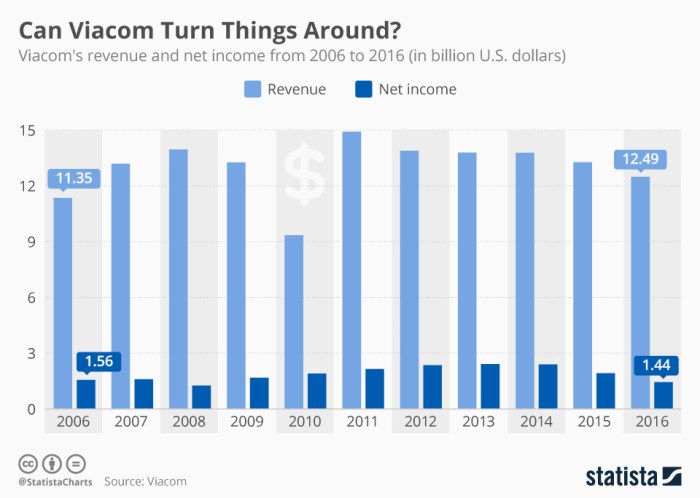
Viacom, a prominent media conglomerate, boasts a diverse asset portfolio that reflects its commitment to entertainment, media, and content creation. This portfolio encompasses a wide range of holdings, from cable networks to movie studios, and investments in emerging technologies. In this segment, we will delve into the specifics of Viacom’s holdings and explore the methodologies used to determine their valuations.
TV Networks and Studios, Net worth of viacom
Viacom owns a significant stake in various television networks, including MTV, Nickelodeon, Comedy Central, and Paramount Network. These networks cater to a broad audience, offering a diverse array of programming that ranges from entertainment news to family-friendly content. Viacom’s studios, such as Paramount Pictures, produce a wide range of films, including blockbuster movies and critically acclaimed dramas. The company’s TV networks and studios generate significant revenue streams, with ad sales, subscriptions, and movie ticket sales contributing to Viacom’s overall earnings.
- MTV Networks: Viacom owns a majority stake in MTV Networks, which includes several cable networks such as MTV, Nickelodeon, and Comedy Central. These networks generate significant revenue through ad sales, subscriptions, and licensing agreements.
- Paramount Pictures: Viacom’s film studio, Paramount Pictures, produces a steady stream of movies, including high-profile blockbusters and critically acclaimed dramas. The studio’s releases contribute to Viacom’s revenue through movie ticket sales and home video distribution.
- Paramount Television: Viacom’s television arm, Paramount Television, produces content for various networks, including cable networks and streaming services. This arm generates revenue through production fees, licensing agreements, and ad sales.
Online Content and Digital Platforms
In recent years, Viacom has made significant investments in digital platforms, including streaming services and online content providers. These platforms offer fans a chance to engage with their favorite content in new and innovative ways, expanding Viacom’s reach and generating new revenue streams.
| Digital Platform | Description |
|---|---|
| Paramount+ | A streaming service offered by ViacomCBS, offering a vast library of content, including movies, TV shows, and documentaries. |
| Nickelodeon All Access | A streaming service offered by ViacomCBS, providing a range of Nickelodeon content, including past episodes and live events. |
| MTV Hits | A streaming service offered by ViacomCBS, focusing on a wide range of music content, including MTV’s iconic music videos and live performances. |
Emerging Technologies and Ventures
Viacom has also made strategic investments in emerging technologies, including virtual reality, augmented reality, and artificial intelligence. These investments reflect the company’s commitment to innovation and its desire to stay ahead of the curve in the rapidly changing media landscape.
"Investing in emerging technologies is essential for Viacom’s continued success. We need to be at the forefront of innovation, not just in content creation, but in the ways we distribute and interact with our audience."
Bob Bakish, CEO of ViacomCBS
These investments have enabled Viacom to explore new revenue streams and create new experiences for its audience, solidifying its position as a leader in the media industry.
Navigating Viacom’s Debt Burden

Viacom, a multinational media conglomerate, has been navigating a significant debt burden that has implications for its financial stability and growth prospects. With a complex web of short- and long-term debt obligations, the company’s ability to manage its debt has become a pressing concern for investors and analysts alike. To understand the extent of Viacom’s debt and its implications, let’s take a closer look at the company’s financial situation.
Current State of Viacom’s Debt
As of 2023, Viacom’s total debt stood at approximately $14.3 billion, comprising both short- and long-term debt obligations. The breakdown of this debt is as follows:
- Short-term debt: $2.5 billion, consisting of commercial paper and current maturities of long-term debt
- Long-term debt: $11.8 billion, including senior notes and other long-term debt obligations
These debt obligations have arisen from various sources, including the company’s acquisition of Paramount Pictures in 2016 and its expansion into digital media through the acquisition of Pluto TV in 2019.
Implications of Debt Burden on Interest Expenses
The significant debt burden has direct implications for Viacom’s interest expenses, which can erode the company’s cash flow and profitability. As per the company’s 2022 financial statements, Viacom’s annual interest expense was approximately $240 million, accounting for about 4% of its total revenue. This interest expense is expected to increase as the company’s debt burden grows.
Given the high interest rates and the large amount of debt, Viacom’s interest expenses are likely to continue increasing, further constraining the company’s financial flexibility.
Debt-to-Equity Ratio and Financial Leverage
Viacom’s debt-to-equity ratio, which measures the proportion of debt to shareholders’ equity, has been increasing over the past few years, indicating a rising level of financial leverage. As of 2023, the company’s debt-to-equity ratio stood at about 2.5:1, indicating that for every dollar of shareholder equity, the company has $2.50 in debt. This level of financial leverage can pose significant risks to the company’s financial stability and make it vulnerable to market fluctuations.
According to a study by Moody’s Investors Service, a high debt-to-equity ratio can lead to reduced credit ratings, increased borrowing costs, and lower profitability.
Strategies to Manage Debt Burden
To mitigate the risks associated with its debt burden, Viacom is exploring various strategies to manage its debt, including:
- Debt refinancing: Viacom is reportedly exploring options to refinance its existing debt at lower interest rates, reducing the company’s interest expenses and extending the maturity of its debt obligations.
- Asset sales: The company is considering selling non-core assets to reduce its debt burden and generate cash flow for debt repayment.
- Cost-cutting measures: Viacom is implementing cost-cutting measures to reduce its operating expenses and improve its financial flexibility.
These strategies aim to reduce the company’s debt burden, improve its financial flexibility, and enhance its long-term growth prospects.
Viacom’s Performance Under Different Economic Scenarios

As a leading media conglomerate, Viacom’s financial performance is heavily influenced by the ever-changing economic landscape. In this section, we will examine how Viacom’s financials hold up under different economic scenarios, simulating various stress tests to assess the company’s resilience. By understanding how Viacom adapts to economic stress, we can gain valuable insights into the company’s financial flexibility and ability to navigate uncertain markets.
Economic Scenario 1: Global Recession
In this hypothetical scenario, we assume a global recession, characterized by a significant decline in consumer spending and a subsequent drop in advertising revenue. To test Viacom’s resilience, we analyze how the company responds to a 20% reduction in ad revenue and a 10% decline in consumer spending.
- Ad revenue shortfall: Viacom’s ad revenue accounts for a significant portion of its total revenue. A 20% reduction in ad revenue would impact the company’s bottom line, leading to a decrease in profitability.
- Consumer spending decline: A 10% decline in consumer spending would further exacerbate the revenue shortfall, as Viacom relies heavily on subscription fees and merchandise sales to generate revenue.
- Cost-cutting measures: To mitigate the impact of the economic downturn, Viacom would likely implement cost-cutting measures, such as reducing discretionary spending, renegotiating contracts with suppliers, and streamlining its operations.
Economic Scenario 2: Shift to Streaming Services
In this scenario, we assume a significant shift towards streaming services, as consumers increasingly opt for online content over traditional broadcast TV. To test Viacom’s adaptability, we analyze how the company responds to a 30% decline in traditional TV viewership and a 20% increase in streaming revenue.
- Decline in traditional TV viewership: As viewers increasingly turn to streaming services, Viacom’s traditional TV viewership would decline, leading to a decrease in ad revenue and subscription fees.
- Increase in streaming revenue: Despite the decline in traditional TV viewership, Viacom’s streaming services would experience a significant increase in revenue, driven by a growing user base and increasing average revenue per user.
- Investment in streaming infrastructure: To capitalize on the growing demand for streaming services, Viacom would likely invest in upgrading its infrastructure, including content creation, distribution, and marketing.
Economic Scenario 3: Geopolitical Uncertainty
In this scenario, we assume an outbreak of geopolitical tensions, leading to a decline in global trade and an increase in costs associated with international operations. To test Viacom’s resilience, we analyze how the company responds to a 15% increase in costs and a 10% decline in revenue.
- Increased costs: Geopolitical tensions would lead to increased costs associated with international operations, including security measures, travel restrictions, and supply chain disruption.
- Revenue decline: As global trade declines, Viacom’s international revenue would suffer, leading to a decrease in profitability.
- Cost management: To mitigate the impact of geopolitical uncertainty, Viacom would likely focus on cost management, including renegotiating contracts with suppliers, streamlining operations, and optimizing its global supply chain.
Key Takeaways
Through these hypothetical scenarios, we have gained insights into Viacom’s financial resilience and its ability to adapt to different economic conditions. Our analysis highlights the company’s need to be agile and responsive to changing market conditions, as well as its ability to diversify its revenue streams and mitigate risks through cost management and strategic investments.
“A company’s ability to adapt to changing market conditions is critical to its long-term success. Viacom’s resilience in the face of economic uncertainty is a testament to its strong financials and its commitment to innovation.”
Conclusion
As we delve into the intricacies of Viacom’s financial landscape, it becomes clear that the company’s net worth is influenced by a complex array of factors, including its revenue streams, asset portfolio, and debt burden. Through a combination of historical analysis, expert insights, and cutting-edge data, this article aims to provide a comprehensive understanding of Viacom’s net worth and the challenges it faces in an evolving media landscape.
Join us on this journey as we explore the highs and lows of Viacom’s financial performance, and discover the fascinating story behind one of the world’s most beloved media brands.
FAQ Compilation
What is Viacom’s primary industry?
Viacom’s primary industries are film, television, and music.
What are some of Viacom’s notable brands?
Viacom owns a range of iconic brands, including MTV, Nickelodeon, and Paramount Pictures.
How does Viacom generate revenue?
Viacom earns revenue through a combination of advertising, subscription fees, and licensing.
What are some of the challenges facing Viacom’s financial performance?
Viacom faces a range of challenges, including increased competition, shifting consumer behavior, and a high debt burden.
