Historical Context of Disproportionate Wealth Concentration

Net worth of 1 percenters – The concentration of wealth among the elite in many developed countries has its roots in the 19th and early 20th centuries, when capitalism and industrialization were transforming the global economy. During this period, the owners of factories, land, and other capital accumulated wealth at an unprecedented rate, while the working class was often left with little more than their labor.
This created a widening gap between the rich and the poor, which has persisted to this day.The Great Depression of the 1930s and World War II further exacerbated this trend, as governments often prioritized the needs of large corporations and wealthy individuals over those of the general population. In the post-war era, the rise of globalization and financialization has further concentrated wealth among the 1 percent.
Today, the owners of corporations, real estate, stocks, and bonds hold an enormous share of global wealth, while the majority of people struggle to make ends meet.
The Perpetuation of Wealth Concentration
Wealth concentration among the 1 percenters is often perpetuated through various mechanisms, including:
- Tax policies: Many countries have tax laws that favor the wealthy and large corporations, allowing them to accumulate wealth without paying their fair share of taxes. Tax loopholes, deductions, and exemptions for certain industries or groups have become increasingly common.
- Inheritance laws: The rules governing inheritance and estate taxes can also contribute to wealth concentration. In many countries, the wealthy are able to pass on their assets to their children or other beneficiaries without paying high taxes, perpetuating their wealth over generations.
- Corporate power structures: Large corporations often wield significant power and influence within the economy and politics. They can shape policies and regulations to benefit themselves and their shareholders, rather than the broader public.
- Globalization: The increased mobility of capital and labor has created a global economy where companies can easily move assets and jobs to places with lower regulatory standards and cheaper labor. This has led to a decline in unionization and workers’ rights, as well as increased income and wealth inequality.
Comparison of Wealth Distribution Patterns
Despite the global nature of these trends, there are significant differences in wealth distribution patterns between developed and developing countries.Developed countries: In many developed countries, particularly in North America and Europe, the concentration of wealth among the 1 percent is evident in the high levels of income and wealth inequality. For example, in the United States, the top 1 percent of earners hold over 20% of the country’s wealth, while the bottom 90% hold less than 30%.
This is largely due to the historical and ongoing legacy of colonialism, slavery, and racism, which have created persistent barriers to social mobility and economic opportunity.Developing countries: In many developing countries, the concentration of wealth among the elite is also a significant issue. However, the dynamics of wealth accumulation are often different from those in developed countries. In some cases, wealth concentration is driven by corrupt practices, such as crony capitalism and embezzlement, rather than purely economic factors.
| Country | Wealth Concentration Index (1-100) |
|---|---|
| United States | 89.3 |
| Canada | 85.1 |
| Australia | 78.2 |
| South Africa | 62.3 |
| India | 55.2 |
According to the World Wealth Report, these indices are based on the concentration of wealth among the top 10% of the population, with higher values indicating greater concentration. These data illustrate the persistent gap in wealth distribution between developed and developing countries.
Unique Factors Contributing to Wealth Concentration
There are various factors unique to individual countries that have contributed to the concentration of wealth among the 1 percent. For example:
- Racial and ethnic disparities: In the United States, the concentration of wealth among white people is much higher than among black or Hispanic people due to historical and ongoing disparities in access to education, housing, and capital.
- Colonial legacy: In many countries, the legacy of colonialism has created ongoing disparities in wealth distribution. For example, in India, the concentration of wealth among the elite is partly due to the historical appropriation of land and resources by British colonizers.
- Crony capitalism: In some developing countries, such as Brazil and Russia, wealth concentration among the elite is driven by crony capitalism and corrupt practices, such as nepotism and bribery.
The Net Worth of 1 Percenters

The 1 percenters – a group of individuals whose net worth surpasses the 99th percentile of the population in their respective countries. These high net worth individuals have been the subject of much attention and scrutiny in recent years, with many questioning how they accumulate such vast fortunes. In this section, we’ll delve into the estimated average net worth of the 1 percenters in various countries, including the United States, United Kingdom, and China, and explore the characteristics that distinguish these individuals from the rest of the population.
Average Net Worth of 1 Percenters in the United States
According to a report by the Federal Reserve, the average net worth of families in the top 1 percent of households in the United States is approximately $11.3 million. In contrast, the median net worth for all households is around $97,000. This disparity is staggering, with the top 1 percent holding around 40 percent of the country’s total wealth. To put this into perspective, if the wealth of the top 1 percent were distributed evenly among all households, each household would receive an additional $170,000.
Characteristics of 1 Percenters: Stocks, Real Estate, and Private Equity
So, what sets these high net worth individuals apart? According to research, the top 1 percenters in the United States tend to hold significant amounts of stocks, real estate, and private equity. Stocks, in particular, are a popular investment choice among the 1 percenters, with many individuals holding stakes in publicly traded companies or private equity firms. Real estate also plays a significant role in the high net worth portfolios of the 1 percenters, with many investing in luxury properties or commercial real estate.
Private equity investments, such as venture capital or hedge funds, are also common among this group.
Examples of 1 Percenters with Net Worth Over $100 Million
While the average net worth of the 1 percenters in the United States is around $11.3 million, there are many individuals whose net worth surpasses $100 million. Some notable examples include:
- Jeff Bezos, founder of Amazon, with a net worth of over $200 billion
- Bill Gates, co-founder of Microsoft, with a net worth of over $150 billion
- Mark Zuckerberg, co-founder and CEO of Facebook, with a net worth of over $100 billion
Financial Instruments and Assets Contributing to High Net Worth
So, what financial instruments and assets contribute to the high net worth of the 1 percenters? According to research, the top 1 percenters tend to hold significant amounts of:
- Stocks, including publicly traded companies and private equity firms
- Real estate, including luxury properties and commercial real estate
- Private equity investments, such as venture capital or hedge funds
- Businesses and corporations, either directly or through portfolio investments
The Challenges and Concerns Associated with the Concentration of Wealth among the 1 Percenters: Net Worth Of 1 Percenters
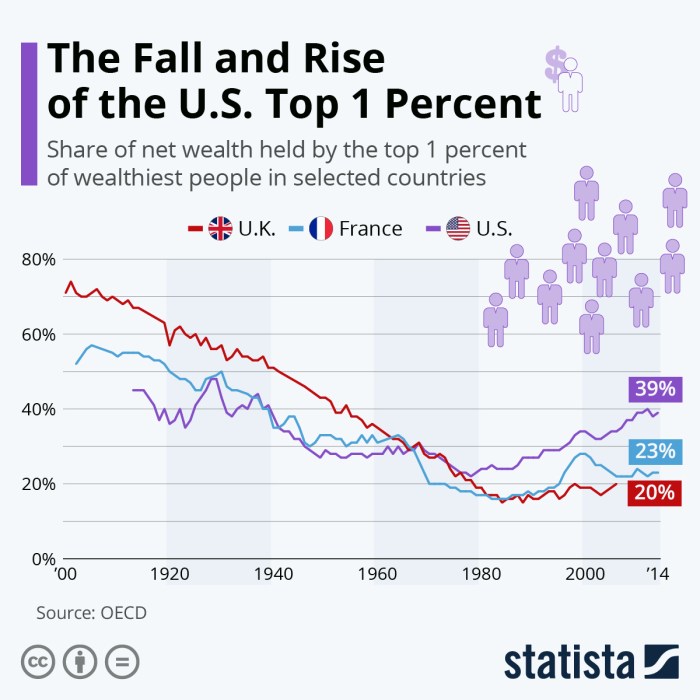
As the concentration of wealth among the 1 percenters continues to grow, concerns about its impact on society and the economy are escalating. The vast disparity in wealth distribution has far-reaching consequences, affecting not only the most vulnerable populations but also the overall stability of the economic system. This concentration of wealth can lead to systemic risks, exacerbate social unrest, and undermine the foundations of economic growth.
The implications are stark: the widening wealth gap can limit social mobility, perpetuate inequality, and even threaten the legitimacy of democratic institutions. As the wealthy elite continues to accumulate power and influence, the voice of the majority becomes increasingly marginalized, leading to a destabilization of the social contract.
Issues related to Inequality and Poverty
In the United States, for example, the Federal Reserve’s Survey of Consumer Finances (SCF) reveals that in 2019, the top 10 percent of households held over 70% of the country’s wealth, while the bottom 50% held less than 1%. This chasm has serious consequences for poverty rates, access to healthcare, education, and basic necessities like housing and food.
The concentration of wealth among the 1 percenters exacerbates these issues, as the wealthy tend to invest in assets that appreciate in value and accumulate wealth over time, while the poor are left with limited opportunities for social mobility.
- According to the Economic Policy Institute (EPI), the median wealth of the top 1% in the United States is estimated to be around $7.7 million, compared to less than $1,700 for the poorest 20%.
- The United Nations Development Programme (UNDP) notes that if current trends continue, the world will reach a tipping point by 2025, where 1% of the population will control more than 80% of global wealth.
- A study by the National Bureau of Economic Research (NBER) found that an increase in wealth inequality is associated with a decline in social cohesion, as measured by metrics such as trust in institutions and social norms.
Systemic Risks and Economic Instability
The concentration of wealth among the 1 percenters contributes to systemic risks, such as market crashes, economic instability, and social unrest, by creating a fragile economic ecosystem. When a small elite controls a disproportionate amount of wealth and assets, it can lead to an over-reliance on speculative investments and a decrease in investment in the real economy.
- A study by the International Monetary Fund (IMF) found that in the lead-up to the 2008 financial crisis, the ratio of debt-to-equity for the top 1% in the United States rose from 2.5:1 to 5.5:1.
- The IMF also notes that an over-reliance on financial assets can lead to asset price bubbles and crashes, contributing to economic instability.
- A study by the Brookings Institution found that the concentration of wealth among the 1 percenters can lead to social unrest, as marginalized groups feel that the economic system is rigged against them.
Potential Solutions to Mitigate Negative Effects
To address the concentration of wealth among the 1 percenters and mitigate its negative effects, policymakers and experts suggest a number of potential solutions, including taxation, regulation, and wealth redistribution.
According to the Economic Policy Institute (EPI), a 10% tax increase on the top 1% could raise an estimated $1.4 trillion in revenue, which could be used to fund essential public services and support low-income households.
| Potential Solution | Description | Ideally Implemented Through |
|---|---|---|
| Taxation | A higher tax rate on the top 1% could help reduce wealth inequality and generate revenue for essential public services. | Legislative action |
| Regulation | Stricter regulations on financial institutions and markets could help prevent asset price bubbles and crashes. | Legislative action |
| Wealth Redistribution | Progressive policies like Universal Basic Income, free education, and affordable healthcare could help reduce wealth inequality and promote social mobility. | Legislative action and public investment |
As the concentration of wealth among the 1 percenters continues to rise, it is essential that policymakers, experts, and the public take action to address these challenges and concerns. By implementing effective solutions and working towards a more equitable distribution of wealth, we can mitigate the negative effects and create a more just and prosperous society for all.
The Impact of Technology on the Concentration of Wealth among the 1 Percenters

The rise of the 1 percenters is closely tied to the rapid advancement of technology in recent decades. From artificial intelligence to blockchain, technology has not only created new opportunities for wealth creation but has also accelerated the concentration of wealth among the top 1%. As we explore the impact of technology on the concentration of wealth, it is essential to understand how technology has become a key driver of this trend.The advent of artificial intelligence, automation, and the gig economy has significantly transformed the job market, with many jobs becoming increasingly automated or commoditized.
This shift has created new opportunities for the 1 percenters to reap the benefits of technological advancements while pushing workers into precarious, low-wage jobs. The gig economy, in particular, has enabled the emergence of platforms like Uber, Lyft, and Airbnb, which have created new channels for the 1 percenters to accumulate wealth.
The Role of High-Frequency Trading in Consolidating Wealth, Net worth of 1 percenters
High-frequency trading (HFT) has become a powerful tool for the 1 percenters to accumulate wealth. HFT involves using algorithms to execute trades at incredibly high speeds, often in a matter of milliseconds. This allows the 1 percenters to capitalize on tiny price discrepancies in the market, generating massive profits.According to a study by the Commodity Futures Trading Commission (CFTC), HFT accounted for over 50% of all trading activity in the US equity market in 2019.
However, the benefits of HFT are not distributed evenly. A report by the Economic Policy Institute (EPI) found that the top 10% of traders in the US accounted for an estimated $1.3 trillion in profits between 2013 and 2018. Meanwhile, the bottom 50% of traders saw a net loss of over $200 billion during the same period.
The Dark Side of Technological Advancements: Job Automation and Wages
Technological advancements have also contributed to the concentration of wealth by automating jobs and reducing wages. According to a report by the McKinsey Global Institute, up to 800 million jobs could be lost worldwide due to automation by 2030. The report also found that while automation can increase productivity, it can also lead to a widening income gap.
Potential Solutions: Promoting Equality of Opportunity and Fair Compensation
While technological advancements have contributed to the concentration of wealth, there are potential solutions to mitigate their negative effects. One approach is to promote equality of opportunity and fair compensation for workers. This can be achieved through policies that:* Increase the minimum wage and indexed it to inflation
- Provide a universal basic income or a guaranteed minimum income
- Implement policies that promote worker ownership and control
- Invest in education and retraining programs to upskill workers
Conclusion
The impact of technology on the concentration of wealth among the 1 percenters is a complex and multifaceted issue. While technological advancements have created new opportunities for wealth creation, they have also accelerated the concentration of wealth among the top 1%. By promoting equality of opportunity and fair compensation for workers, we can mitigate the negative effects of technology and create a more equitable economy for all.As we move forward, it is essential to recognize the role of technology in shaping the future of work and wealth.
By understanding the impact of technology and working towards a more equitable economy, we can create a world where everyone has the opportunity to thrive.
The Cultural and Social Influences that Perpetuate the Concentration of Wealth among the 1 Percenters

In a society where wealth and material success are often touted as the ultimate markers of achievement, it’s little wonder that the 1 percenters – those individuals who own an disproportionate share of the world’s wealth – are able to maintain their grip on power. From the opulent mansions that line the hills of Beverly Hills to the gilded halls of Wall Street, the trappings of wealth are everywhere, perpetuating the notion that money equals power and prestige.One of the most insidious effects of this cultural narrative is its ability to justify and legitimize the concentration of wealth among the 1 percenters.
After all, if having more money is seen as the ultimate prize, then it’s only logical that those who have more are more deserving of their privileged status. This, in turn, perpetuates a cycle of inequality, as those who already own more wealth have more opportunities to accumulate even more, while those with less are left further behind.
Celebrity Culture and the Glorification of Wealth
Celebrities, with their lavish lifestyles and luxurious possessions, often find themselves at the forefront of this culture war. By celebrating their wealth and material success, the media perpetuates the notion that having more is better, and that the pursuit of wealth is a worthy and attainable goal. This can lead to a culture of envy and competition, where individuals feel pressure to keep up with their peers and conform to societal expectations.
- The social media era has created a platform for celebrities to flaunt their wealth, often with millions of followers hanging on their every post. Whether it’s a vacation in a private island or a new designer handbag, the message is clear: more is better.
- TV shows like “Rich Kids of Beverly Hills” and “Million Dollar Listing” glamourize the lives of the wealthy, portraying them as aspirational and desirable.
- The music industry has long been a haven for celebrities to brag about their wealth, with lyrics often glorifying material possessions and lavish lifestyles.
The Role of Education in Perpetuating Inequality
Education is often touted as a great equalizer, providing opportunities for social mobility and upward mobility. However, when it comes to the 1 percenters, education can also serve as a means of perpetuating inequality. By attending elite universities and networking with high-powered individuals, the wealthy can secure jobs and opportunities that are largely unavailable to those from less privileged backgrounds.
According to a study by the Economic Policy Institute, a staggering 43% of the top 1% of earners in the US hold a graduate degree, compared to just 12% of the bottom 90%.
Challenging the Status Quo: Solutions to Promote Greater Equality and Social Justice
So what can be done to challenge the cultural and social norms that perpetuate the concentration of wealth among the 1 percenters? Here are a few potential solutions:
- Education: By promoting affordable and accessible education, we can create opportunities for social mobility and reduce inequality.
- Taxes: Implementing a more progressive tax system, where the wealthy are taxed at a higher rate, can help redistribute wealth and promote greater economic equality.
- Celebrating the Underrepresented: By celebrating the achievements of underrepresented groups and promoting diversity in media and popular culture, we can create a more inclusive and equitable society where wealth is not the only measure of success.
Last Word
As we conclude this exploration of the net worth of 1 percenters, it’s clear that their wealth and influence continue to shape our world in profound ways. While their stories are filled with intrigue and privilege, they also raise important questions about the distribution of wealth, social mobility, and the future of our society. It’s up to us to consider the implications of their power and to navigate the complex issues that arise from their concentration of wealth.
FAQ Summary
What is the average net worth of a 1 percenter in the United States?
According to various sources, the average net worth of a 1 percenter in the United States is around $10 million to $15 million.
How do 1 percenters typically accumulate their wealth?
1 percenters tend to accumulate their wealth through a combination of inheritance, business ventures, investments, and strategic financial instruments such as stocks, bonds, real estate, and private equity.
What is the relationship between wealth concentration and social mobility?
The concentration of wealth among 1 percenters can limit social mobility by creating a self-perpetuating cycle of privilege and access to opportunities.
How do 1 percenters use their wealth and influence to shape politics and business?
1 percenters use their wealth and influence to shape politics and business through various means, including lobbying, campaign contributions, strategic alliances, and advocacy for policies that benefit their interests.
