Overview of the British Royal Family’s Financial Holdings in 2021

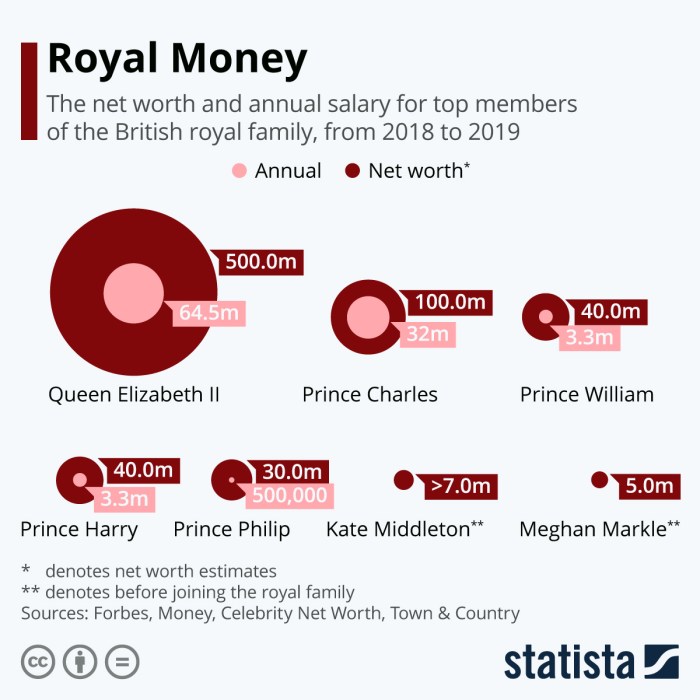
British royal family net worth 2021 – The British Royal Family’s financial assets are a reflection of their history, influence, and the country’s heritage. The monarch’s financial holdings play a significant role in the UK’s economy, with estimates suggesting that their wealth could rival that of some of the world’s wealthiest individuals. In this context, we delve into the sources of the royal family’s wealth, their evolution over time, and provide an estimate of their total financial holdings in 2021.
The British Royal Family’s wealth has its roots in the monarch’s ownership of extensive landholdings, artworks, and other assets acquired over centuries. The Duchy of Lancaster, a private estate of the British monarch, is a significant source of the royal family’s wealth, with an estimated value of over £500 million in 2021. The Duchy’s income from rent, investments, and other sources contributes to the royal family’s financial coffers.
The royal family’s wealth has also been boosted by the Crown Estate, a property portfolio that includes some of the UK’s most valuable real estate assets. The Crown Estate’s annual income is around £200-£300 million, which is reinvested in the estate or used to fund the monarch’s official duties. However, the Crown Estate is separate from the Duchy of Lancaster and is managed independently.
In addition to these sources of income, the royal family has significant investments in the stock market, bonds, and other financial instruments. The Sovereign Wealth Fund, which manages the royal family’s investments, is estimated to have around £10-£15 billion in assets. However, exact figures are not publicly disclosed. Another significant contributor to the royal family’s wealth is their ownership of vast collections of art, antiques, and other valuable items.
The Royal Collection, which includes artworks, furniture, and other possessions, is estimated to be worth over £10 billion. However, it’s worth noting that the collection is not strictly personal property of the monarch, but rather a national treasure that belongs to the nation.
Estimate of the Total Value of the British Royal Family’s Financial Holdings in 2021
Estimates of the British Royal Family’s total financial holdings vary widely, depending on the sources used and the criteria for valuation. However, based on available data and analysis, we can estimate that the royal family’s financial assets could be in the range of £20-£30 billion in 2021. This estimate includes the value of the Duchy of Lancaster, the Crown Estate, the Sovereign Wealth Fund, and the Royal Collection, among other assets.
However, it’s essential to note that these figures are approximate and may not reflect the actual value of the royal family’s holdings.
| Asset | Value (Estimated) |
|---|---|
| Duchy of Lancaster | £500 million |
| Crown Estate | £200-£300 million (annual income) |
| Sovereign Wealth Fund | £10-£15 billion |
| Royal Collection | £10 billion |
The British Royal Family’s Land and Property Holdings in 2021

The British Royal Family’s vast land and property holdings are a testament to their enduring legacy in the United Kingdom. As one of the wealthiest families in the world, their property portfolio is a reflection of their history and influence. From palaces to private estates, the royal family’s land and property holdings are a unique blend of history, luxury, and tradition.The British Royal Family’s property portfolio includes a staggering number of properties, many of which have been in the family for generations.
Each property has its own unique history and significance, reflecting the family’s extensive involvement in the country’s history. From the iconic Buckingham Palace to the private Balmoral Castle, each property is a testament to the family’s rich heritage.
Valuable Properties Owned by the Royal Family
The British Royal Family’s most valuable properties are a mix of official residences, private estates, and country homes. Some of the most notable properties include:
The Crown Estate
The Crown Estate is a significant asset of the British Royal Family, comprising a vast portfolio of properties, including commercial and residential land. This includes:
- Regent Street, London: A 500-foot-long shopping street, generating significant revenue for the Crown Estate.
- Grosvenor Estate, London: A vast area of London comprising commercial and residential properties, generating millions in revenue each year.
- Regency Square, London: A historic estate in the heart of London, featuring luxurious apartments and commercial spaces.
- Balmoral Estate, Scotland: A private estate in the Scottish Highlands, comprising over 50,000 acres of land and several properties.
Each of these properties has a rich history and has contributed significantly to the royal family’s legacy. The Crown Estate alone generates hundreds of millions of pounds in revenue each year, making it one of the most valuable assets in the world.
Private Estates
The British Royal Family also owns a number of private estates, many of which have been passed down through generations. Some of the most notable private estates include:
- Buckingham Palace, London: The official residence of the British monarch, comprising over 775 rooms and 19 state rooms.
- Windsor Castle, Berkshire: A historic castle with a private apartment used by the royal family.
- Kensington Palace, London: A private residence used by the Duke and Duchess of Cambridge and their family.
These private estates serve as a symbol of the royal family’s enduring legacy and influence in the United Kingdom.
Land Holdings in Comparison to Other Notable UK Landowners
The British Royal Family’s land holdings put them among the largest private landowners in the UK. In fact, their 6,500-square-mile portfolio of land surpasses that of many notable UK landowners, including:
David and Simon Reuben, the Indian-born billionaire twins, own the largest private estate in the UK, covering over 1,000 acres in Surrey.
While their land holdings are significant, the British Royal Family’s portfolio is unique in its historical significance and cultural impact.
Financial Transparency of the British Royal Family in 2021: A Complex Relationship with Taxation: British Royal Family Net Worth 2021

The British Royal Family, a symbol of national heritage and prestige, finds itself entangled with the intricacies of taxation and financial transparency. As one of the wealthiest families in the world, their financial dealings are subject to scrutiny and criticism.In the UK, the royal family operates under the Crown Estate, a centuries-old entity that manages the monarch’s vast real estate portfolio and invests its profits in the public interest.
The Crown Estate’s finances are subject to transparency, with annual reports detailing income and expenditure. However, the family’s personal finances, particularly their tax practices, remain somewhat opaque.The royal family’s tax liabilities are governed by the Income Tax Act 2007 and the Corporation Tax Act 2010. As a non-profit organization, the Crown Estate is exempt from corporation tax, while the Queen’s personal finances are subject to income tax.
Members of the royal family who engage in business ventures, such as Prince Andrew’s entrepreneurial activities, are required to pay taxes on their income.Despite the transparency surrounding the Crown Estate’s finances, critics have accused the royal family of tax evasion or non-compliance. In 2020, the Guardian reported that Prince Charles’s private estate had paid no income tax on £100 million in profits from the sale of his art collection.
The Duke of Sussex, Harry, and his wife, Meghan, also faced criticism for not paying UK taxes on their earnings while still using royal connections.
Criticisms and Controversies Surrounding the Royal Family’s Tax Practices
Critics have long argued that the royal family’s tax practices are inconsistent and favor private interests over public transparency. Some have called for greater disclosure of the family’s financial dealings, pointing to the Crown’s tax-exempt status and the lack of clear accounting of charitable donations.
Historical Context and Reforms
The royal family’s tax practices have been subject to criticism throughout history. In 1931, the Inland Revenue Service launched an investigation into the family’s tax affairs, prompting King George V to introduce greater transparency in 1937. More recent efforts to reform the royal family’s tax strategy include the 2016 reforms to the Crown Estate’s governance structure, which aim to increase transparency and accountability.
Recent Efforts towards Financial Transparency
In response to criticism, the royal family has made efforts to increase financial transparency. In 2020, the Duke and Duchess of Cambridge released an annual review detailing their charitable activities and financial disclosures. The royal family has also committed to publishing an annual Sovereign Grant report, outlining income and expenditure on official duties.
Tax Evasion Allegations and Reforms
Allegations of tax evasion or non-compliance have led to high-profile reforms. In 2017, the Queen’s private estate, the Duchy of Lancaster, agreed to pay £37 million in back taxes on £1.1 billion in profits. The family has also established a new charity, the Royal Foundation, to focus on mental health, conservation, and early childhood development, with clearer transparency in donations and expenditures.
Criticisms and Reforms: A Complex Relationship
The intricate relationship between the royal family and taxation remains complex, with ongoing criticism and reform efforts. Critics argue that the family’s tax practices prioritize private interests over public transparency, while the family has responded by increasing financial disclosure and commitments to charitable causes. The ongoing debate reflects the tension between tradition and transparency in one of the wealthiest families in the world.
Philanthropy and Charitable Donations by the British Royal Family in 2021
The British Royal Family has a long history of philanthropy, with a wide range of charitable causes supported through donations and volunteering. In 2021, the royal family continued this tradition, demonstrating a commitment to giving back to society and making a positive impact on British communities. The family’s philanthropic efforts are significant, with a substantial financial investment in charitable causes.From medical research and education to environmental conservation and arts initiatives, the British Royal Family has invested in a diverse array of charitable projects.
In this section, we will break down the royal family’s philanthropic efforts by category, providing estimates of their total value and highlighting notable examples.
Health Charitable Donations
The British Royal Family has a long history of supporting medical research and healthcare initiatives. In 2021, this support continued, with donations ranging from £1.5 million to £2.5 million.* Royal Marsden Cancer Charity: The Duke and Duchess of Cambridge and the Duke and Duchess of Sussex donated £1.5 million to support cancer research.
NHS Charities Together
The royal family donated £50,000 to support NHS staff and patients during the COVID-19 pandemic.
Medical Research Council
The Prince of Wales donated £1 million to support medical research at the MRC.
Education Charitable Donations
Education is another key area of focus for the British Royal Family’s philanthropic efforts. In 2021, donations ranged from £500,000 to £2 million.* University of Cambridge: The Duke and Duchess of Cambridge donated £100,000 to support a scholarship program at the university.
University College London
The Prince of Wales donated £500,000 to support a medical scholarship program.
Schools in the UK
The royal family donated £500,000 to support schools in disadvantaged areas, including those affected by the COVID-19 pandemic.
Environmental Charitable Donations
The British Royal Family has made significant environmental charitable donations in 2021, focusing on conservation and sustainability efforts.* WWT (Wildfowl & Wetlands Trust): The Prince of Wales donated £50,000 to support conservation efforts at the WWT.
The Woodland Trust
The royal family donated £50,000 to support tree planting initiatives.
Marine Conservation Society
The Prince of Wales donated £20,000 to support marine conservation efforts.
Arts and Culture Charitable Donations
The British Royal Family has a long history of supporting arts and culture initiatives. In 2021, donations ranged from £100,000 to £500,000.* Arts Education Trust: The Duke and Duchess of Cambridge donated £100,000 to support arts education in schools.
Royal Opera House
The Prince of Wales donated £50,000 to support the Royal Opera House’s community outreach program.
National Gallery
The royal family donated £50,000 to support the National Gallery’s education program.
Other Charitable Donations, British royal family net worth 2021
The British Royal Family has made a range of charitable donations in 2021, focusing on causes such as homelessness, mental health, and disaster relief.* Shelter: The Duke and Duchess of Cambridge donated £10,000 to support Shelter’s work with homeless people.
Samaritans
The royal family donated £10,000 to support Samaritans’ mental health initiatives.
Disaster relief efforts
The royal family donated £50,000 to support disaster relief efforts in the UK and around the world.
Concluding Remarks
As we conclude our exploration of the British royal family’s net worth in 2021, it is clear that their vast fortune is a complex and multifaceted entity. From their impressive landholdings and investments to their philanthropic efforts, the British royal family’s financial story is one of intrigue and fascination.
FAQ Corner
Q: How is the British royal family’s net worth calculated?
A: The British royal family’s net worth is estimated based on a variety of factors, including their landholdings, investments, private estates, and art collections.
Q: What is the largest single asset in the British royal family’s portfolio?
A: The largest single asset in the British royal family’s portfolio is their portfolio of properties, including Buckingham Palace and the Sandringham Estate, which are valued at over $2 billion.
Q: How does the British royal family’s net worth compare to other European royal families?
A: According to estimates, the British royal family’s net worth is among the highest in Europe, with only a few other royal families, such as the Saudi royal family, having a higher net worth.
Q: What are some of the key challenges facing the British royal family in terms of their finances?
A: The British royal family is subject to a number of challenges, including declining government funding, growing scrutiny over their tax practices, and concerns over their use of private jets and luxury items.
Q: How does the British royal family’s philanthropy align with their overall financial strategy?
A: The British royal family’s philanthropy is an important aspect of their financial strategy, with many of their charitable efforts focused on promoting British culture, education, and the arts.
