The correlation between net worth and age in 2021.: Net Worth Of The World 2021

Net worth of the world 2021 – As people age, their financial situations often undergo significant changes. The correlation between net worth and age is a complex one, influenced by various factors such as earning potential, spending habits, and investment strategies. In 2021, the average net worth of adults in different age groups varied significantly, reflecting the challenges faced by retirees and older adults.According to data from the Federal Reserve, the average net worth of households in the United States aged 65 and older was significantly lower than that of younger age groups.
In 2021, the average net worth for households in this age group was $254,700, compared to $1.05 million for households aged 55-64, and $2.53 million for households aged 45-54. This disparity highlights the financial challenges faced by retirees and older adults, who often struggle to maintain their standard of living in retirement.
Financial Challenges Faced by Retirees and Older Adults, Net worth of the world 2021
Retirees and older adults face a range of financial challenges, including reduced income, increased healthcare expenses, and decreased investment opportunities. According to a survey conducted by the Employee Benefit Research Institute (EBRI), 62% of retirees reported that they were not financially prepared for retirement, and 55% said they were concerned about outliving their retirement savings.Here are some key statistics highlighting the financial challenges faced by retirees and older adults:
- 64% of retirees report that their income has decreased since retirement.
- The average healthcare expenses for an American family increase by $2,200 annually after age 65.
- The Social Security Administration reports that the average monthly Social Security benefit for a retired worker is $1,657.
- 63% of retirees report that they rely on Social Security as their primary source of income.
Importance of Long-Term Financial Planning
To maintain a sustainable lifestyle in retirement, it is essential to have a well-thought-out financial plan in place. Long-term financial planning involves setting clear financial goals, developing a strategy for achieving them, and regularly reviewing and adjusting the plan as needed.Here are some key steps to creating a successful retirement plan:
- Assess your current financial situation and create a budget.
- Determine your retirement goals and develop a plan for achieving them.
- Invest in a diversified portfolio of assets, such as stocks, bonds, and real estate.
- Consider working with a financial advisor or planner to ensure your plan is comprehensive and up-to-date.
- Regularly review and adjust your plan to ensure you are on track to meet your retirement goals.
Age-Related Health Issues and their Impact on Net Worth
As people age, they are more likely to experience age-related health issues, which can significantly impact their net worth. According to the Centers for Disease Control and Prevention (CDC), the cost of healthcare in the United States is expected to increase by 5.8% annually from 2020 to 2030.Here are some key statistics highlighting the impact of age-related health issues on net worth:
- The average annual healthcare expenses for an American family increase by $2,200 annually after age 65.
- The cost of long-term care services, such as nursing home care, can exceed $100,000 per year.
- The Social Security Administration reports that the average monthly Social Security benefit for a disabled worker is $1,197.
- 63% of retirees report that they rely on Social Security as their primary source of income.
Healthcare-Related Financial Implications and Mitigation Strategies
To mitigate the impact of age-related health issues on net worth, individuals can take several steps:
- Invest in a long-term care insurance policy to cover potential healthcare expenses.
- Create a healthcare Savings Plan, such as a Health Savings Account (HSA), to save for future healthcare expenses.
- Consider working with a financial advisor or planner to ensure your plan is comprehensive and up-to-date.
- Regularly review and adjust your plan to ensure you are on track to meet your retirement goals.
Regional Disparities in Net Worth Distribution in 2021

As the world continues to grapple with the aftermath of the 2008 global financial crisis, one aspect that has gained significant attention is the disparity in net worth distribution across different regions. This disparity has far-reaching implications, from economic development to social inequality. In this section, we will delve into the financial implications of the 2008 crisis on regional net worth, as well as regional economic policies that promote wealth creation.The 2008 global financial crisis had a devastating impact on many regions, particularly those with fragile economies.
One region that was severely affected was Eastern Europe. The crisis led to a significant decline in property prices, a sharp decrease in exports, and a severe credit crunch. According to a report by the International Monetary Fund (IMF), the total losses incurred by the countries of Eastern Europe during the crisis were estimated to be around $500 billion. This not only resulted in significant economic losses but also had a profound impact on the region’s net worth.
The Case Study of Eastern Europe: Financial Implications of the 2008 Crisis
- The financial crisis led to a sharp decline in property prices, with some areas experiencing a decline of up to 70%.
- The crisis also led to a severe credit crunch, making it difficult for businesses and individuals to access credit.
- The sharp decline in exports had a significant impact on the region’s trade balance, leading to a severe decline in GDP growth rates.
- The crisis also led to a significant increase in unemployment rates, with some countries experiencing levels as high as 20%.
The crisis had a profound impact on the region’s net worth, as assets prices declined significantly and debt levels increased. According to a report by the European Bank for Reconstruction and Development (EBRD), the total debt of the countries of Eastern Europe increased by over 50% between 2007 and 2012.
Regional Economic Policies That Promote Wealth Creation
| Economic Policy | Description |
|---|---|
| Investment in Infrastructure | Investing in infrastructure such as roads, bridges, and public transportation not only improves the quality of life but also attracts businesses and talent. |
| Education and Training | Investing in education and training programs helps to develop a skilled workforce, which is essential for attracting businesses and promoting economic growth. |
| Encouraging Entrepreneurship | Encouraging entrepreneurship through programs such as tax breaks and low-interest loans helps to create new businesses and promote job creation. |
Economic Resilience of Different Regions
- Some regions, such as the Nordic countries, have exhibited exceptional resilience in the face of financial shocks.
- These countries have a well-diversified economy, a strong financial system, and a highly skilled workforce.
- They have also invested heavily in education and training programs, which has helped to develop a highly skilled workforce.
Potential Future Economic Challenges
- The COVID-19 pandemic has raised concerns about the global economic outlook, particularly for regions with fragile economies.
- Climate change is also expected to have a significant impact on regional economies, particularly those that are highly dependent on natural resources.
- Regional economic policies that promote wealth creation, such as investment in infrastructure and education, will be crucial in addressing these challenges.
Global wealth concentration in 2021.
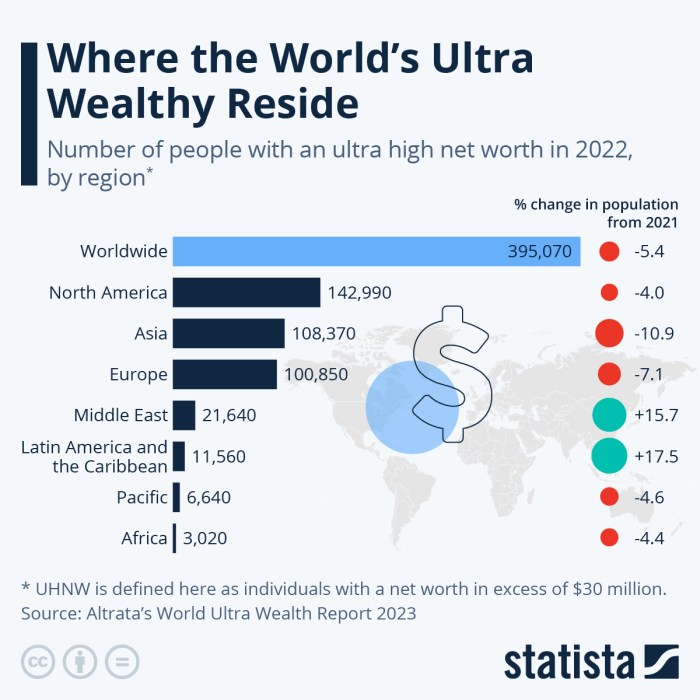
The world’s wealthiest individuals have seen their net worth surge to unprecedented levels, while the vast majority of the global population remains impoverished. According to the latest global wealth reports, the richest 1% of the population now controls over 38% of the world’s wealth, further exacerbating the wealth gap. The concentration of wealth at the top has far-reaching consequences, including reduced economic mobility, decreased social stability, and a dwindling middle class.
The Global Wealth Concentration Pyramid
Imagine a pyramid, with the base representing the majority of the population holding little to no wealth. As we move up the pyramid, the concentration of wealth increases, with the top layer comprising the wealthiest 1% of the population. Below is a breakdown of the global wealth concentration pyramid in 2021:
| Level | Net Worth (USD) | Percentage of Global Wealth | Number of Individuals |
|---|---|---|---|
| Base | $0 – $10,000 | 1% | 4.3 billion |
| Middle | $10,000 – $100,000 | 10% | 840 million |
| Upper Middle | $100,000 – $1 million | 20% | 170 million |
| Top 1% | $1 million+ | 38% | 26 million |
Financial Instruments and Vehicles Facilitating Wealth Concentration
The concentration of wealth at the top is often facilitated by complex financial instruments and vehicles, including:
- Privatized equity and securities
- Hedge funds and private equity funds
- Complex derivatives and financial contracts
- Tax-advantaged accounts and structures
- Offshore banking and tax havens
These financial instruments and vehicles enable the wealthy to manage risk, invest in assets, and minimize their tax liabilities, further exacerbating the wealth gap. The widespread use of these instruments has led to a surge in wealth concentration, with the richest 1% now controlling an estimated 38% of the world’s wealth.
Asset Management Fees and Net Worth Growth
The wealthy often employ professional asset managers to oversee their investments, incurring significant fees in the process. These fees can range from 0.5% to 2% of the total asset value, depending on the type of investment and the level of management required. The impact of asset management fees on net worth growth can be significant, as these fees are often deducted from the investment returns, reducing the overall growth rate.
For example, a $1 million investment earning a 7% annual return would result in $70,000 in net gains. However, if the investor incurs a 1% management fee, the net gains would be reduced to $67,000, a loss of $3,000 in value.
Passive and Active Investment Strategies
Investors can adopt passive or active investment strategies to manage their investments. Passive investment strategies focus on long-term growth and typically involve investing in index funds or ETFs that track a specific market index. Active investment strategies, on the other hand, involve actively managing the investment portfolio, seeking to outperform the market through a variety of techniques, including stock picking and sector rotation.
Benefits and Drawbacks of Passive and Active Investment Strategies
Passive investment strategies offer several benefits, including lower fees, reduced risk, and lower administrative costs. However, active investment strategies can provide higher returns over the long term, especially for investors with a high tolerance for risk. The drawbacks of passive investment strategies include lower returns, reduced tax efficiency, and limited flexibility in investment choices. Active investment strategies, on the other hand, can be more expensive, riskier, and may not provide the desired returns, especially for investors with limited investment expertise.
Conclusion

In conclusion, the net worth of the world in 2021 is a multifaceted issue with far-reaching implications. As we navigate the complexities of global wealth disparities, it’s essential to consider the long-term consequences of our economic systems and the impact on future generations. By understanding the intricate relationships between demographic factors, technological advancements, and economic systems, we can work towards creating a more equitable and sustainable global economy.
Top FAQs
What is the current global net worth?
The current global net worth stands at approximately $360 trillion.
How does income inequality affect the global net worth distribution?
Income inequality significantly contributes to global net worth disparities, with the top 1% holding a disproportionate share of the world’s wealth.
What is the role of economic systems in shaping global net worth?
Economic systems, such as capitalism and socialism, influence the distribution of wealth and contribute to net worth disparities.
How does technological advancements impact global net worth?
Technological advancements, such as the digital revolution, can both create and exacerbate wealth disparities through unequal access to new opportunities and economic benefits.
